
Introduction
Table of Contents
- Introduction
- Australian privacy framework for AI and personal data
- Data centre security, hosting and cross-border data transfers
- Transparency, data accuracy and automated decision-making duties
- Sector, state and lifecycle considerations for AI privacy
- Practical tips to make Australian privacy work in AI projects
- Conclusion and next steps for AI-ready Australian privacy
If you are building or buying AI in Australia, understanding data Australian privacy is no longer optional. Personal information moves through training pipelines, models and APIs at high speed, and regulators are watching more closely than ever. For founders, CIOs and data leaders, the real risk is not just fines – it is loss of trust, stalled deployments and having to rip out AI systems at the last minute.
This article breaks down how key Australian Privacy Principles (APPs) and recent reforms apply to AI. We unpack hosting and cross-border decisions, security expectations, transparency rules and emerging proposals around new disclosure duties for impactful automated decisions. By the end, you will have a practical checklist to keep your AI roadmap aligned with local privacy expectations and ready to scale, and see how a secure Australian AI assistant can sit comfortably inside that framework.
Australian privacy framework for AI and personal data
Australian privacy law does not run on a separate track for AI. Instead, AI projects sit under the existing Privacy Act and the Australian Privacy Principles, with the Office of the Australian Information Commissioner (OAIC) clarifying how those rules apply to machine learning, automation and data products. That means your AI roadmap must be anchored in APP 1, 5, 8, 10 and 11 from day one, not bolted on at go-live, and why many teams lean on specialist AI privacy-aligned services to interpret those obligations.
APP 1 requires open and transparent management of personal information, including clear privacy policies that explain how you use data in AI contexts. APP 5 adds a duty to notify individuals when you collect their personal information and to explain the purposes, typical disclosures and any unusual uses. For AI teams, this means you cannot quietly repurpose customer data for model training without checking whether your existing notices already cover that use or whether you need updated wording and fresh consent pathways, a point reinforced in recent OAIC guidance on using commercially available AI.
Accuracy and quality of data are handled mainly by APP 10. Under this principle, organisations must take reasonable steps to ensure that personal information used and generated in AI systems is accurate, up-to-date, complete and relevant. In practice, that affects your data-prep pipelines, model retraining schedules and any human-in-the-loop checks around high-impact use cases. If a model makes decisions about credit, healthcare access or employment based on stale or partial records, you risk harm and potential breaches of APP 10, which Australian privacy regulators increasingly highlight in their analysis of AI regulation trends.
APP 11 then focuses on security. OAIC guidance stresses that entities must take “reasonable security measures” to protect personal information inside AI systems from unauthorised access, modification or misuse. The regulator does not prescribe specific technical standards like ISO 27001, SOC 2 or concrete encryption schemes. You have flexibility to choose controls that match your risk profile, but you must be able to justify them as reasonable if challenged.
Across all these principles, the OAIC promotes Privacy by Design and the use of Privacy Impact Assessments (PIAs) across the AI lifecycle. Rather than waiting until deployment, a well-run PIA will test your data flows, retention rules and user disclosures while the solution is still on the whiteboard. For fast-moving product teams, building privacy review gates into sprint ceremonies is often the only way to keep experimentation nimble and still stay inside the legal guardrails, something that well-structured professional AI implementation services can bake into your delivery process. https://www.oaic.gov.au/privacy/australian-privacy-principles
Data centre security, hosting and cross-border data transfers
One of the biggest questions for AI workloads is where to host. Many Australian organisations assume privacy law forces them to keep all data onshore, but that is not how the current framework works. The OAIC does not require AI workloads involving personal information to be hosted exclusively in Australian data centres, focusing instead on compliance with the Australian Privacy Principles (APPs) regardless of where the data is processed, a position reflected in global AI regulatory trackers for Australia.
Under APP 8, when personal information is processed on overseas infrastructure, you must ensure that appropriate protections are in place. That usually means performing a structured assessment of the recipient country, the provider’s contractual commitments and their technical and organisational security measures. It is not enough to simply trust that a large cloud provider “must be secure”; you should be able to point to documented due diligence, including input from your internal privacy and security teams.
APP 11 overlays a general security obligation: organisations must take reasonable steps to protect personal information in AI systems from unauthorised access, misuse, interference or loss. The OAIC guidance emphasises reasonable security measures but deliberately stops short of naming mandatory certifications or encryption levels. In the AI context, reasonable measures commonly include role-based access control around training data, encrypted storage and transit, logging and monitoring of model access, and strong key management for API-based services, all of which should be reflected in your chosen AI automation and custom model architecture.
Because there is no general Australian data residency mandate under the Privacy Act, you can legitimately choose offshore compute for training or inference for most types of personal information, provided APP 8 and 11 duties are managed and no sector‑specific data localisation laws (such as those applying to some health records) apply. Many organisations still prefer local data centres for latency, network control or risk appetite reasons. Where you do select overseas regions, it is wise to separate clearly between de-identified or synthetic datasets (which may fall outside the Privacy Act) and live, identifiable personal information, which will attract the full APP 8 regime and more intense stakeholder scrutiny.
A practical hosting decision process for AI typically includes: mapping all data categories, classifying what counts as personal information, checking whether any data relates to vulnerable cohorts, then scoring each hosting option against security, regulatory exposure and business needs. Bringing privacy counsel, CISO teams and product owners into a joint workshop early can prevent late-stage surprises, especially when an attractive AI platform only runs from overseas regions. Ultimately, what the OAIC expects is not perfection but a traceable, risk-based rationale for your architecture choices, a standard also reflected in commentary on OAIC’s dual AI privacy guidelines. https://www.oaic.gov.au/privacy/australian-privacy-principles-guidelines/chapter-8-app-8-cross-border-disclosure-of-personal-information
Transparency, data accuracy and automated decision-making duties
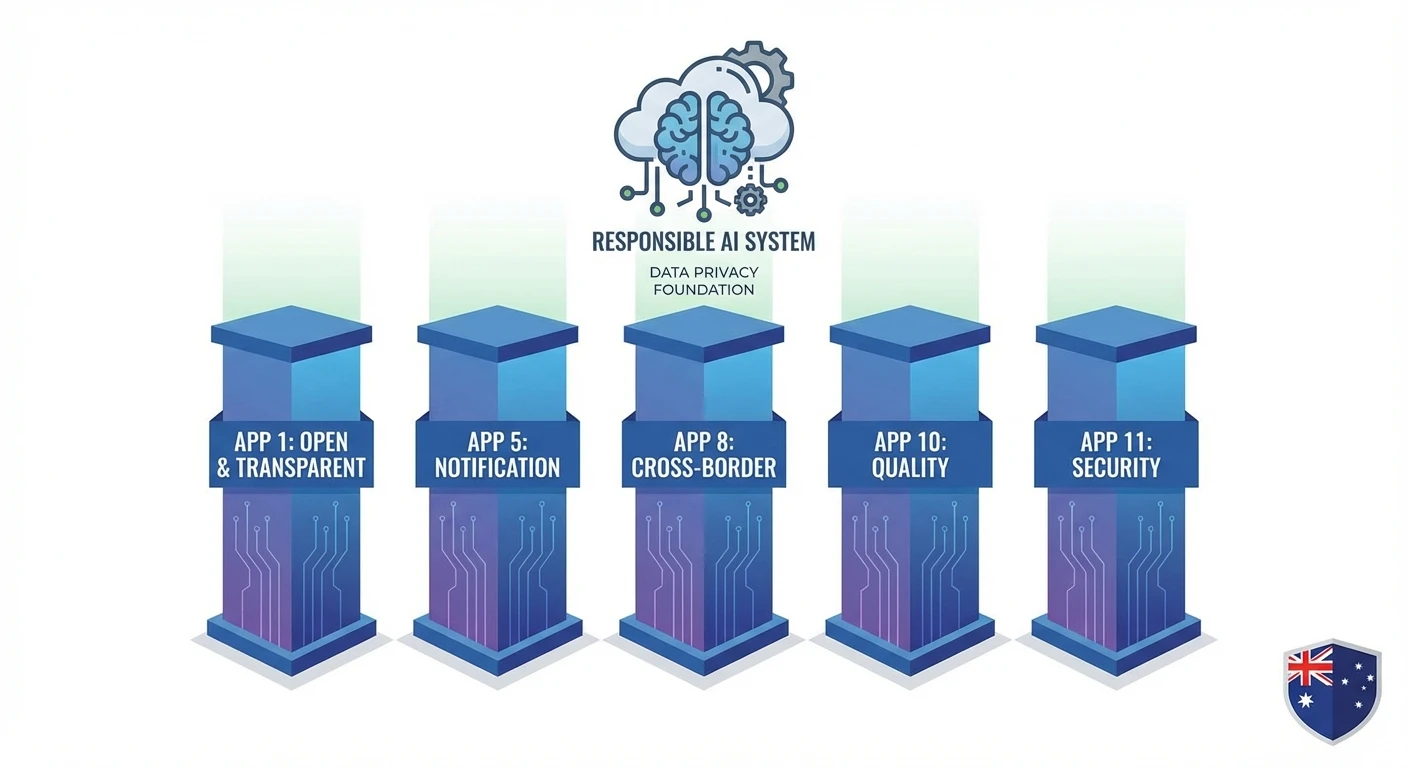
Transparency sits at the heart of Australian privacy law, and AI is no exception. When you introduce automated decision-making, the combination of APP 1, APP 5, APP 10 and the new 2024 reforms creates sharper expectations around what you tell people and how you manage their information over time.
Under APP 1, your privacy policy must explain in a clear and accessible way how you handle personal information, including any use in AI systems or automated tools. Generic wording about “improving our services” will rarely be enough if you are using detailed behavioural data to train algorithms that influence pricing, eligibility or content ranking. People should be able to read your policy and understand, in plain terms, that their data may be analysed or profiled by computer programs, and for what general purposes.
APP 5 adds a more dynamic layer, requiring you to notify individuals at or before the time you collect their personal information. For AI-driven products, this can be done through layered notices: a short, direct explanation at the key interaction point with links to more detailed information for those who want it. A sign-up flow might specify that certain account data will be used to personalise recommendations or to detect fraud using automated systems, rather than burying this detail deep in legal text.
APP 10 focuses on ensuring that personal information used and generated across the AI lifecycle is accurate, up-to-date, complete and relevant. That means more than a one-off data clean at launch. It requires ongoing processes like regular data quality checks, mechanisms for individuals to correct their records, and controls to stop models from relying on information that has become obsolete or misleading. In a practical sense, data and ML engineers need to treat accuracy as a functional requirement, not a nice-to-have.
The Privacy and Other Legislation Amendment Act 2024 adds an important new twist by ramping up transparency obligations around automated decision-making and how personal information feeds into those systems. Where automated decision-making could significantly affect an individual’s rights or interests, organisations will, from 10 December 2026, be required to disclose in their privacy policy that personal information is used in the computer program making that decision, and the kinds of personal information involved. This ties algorithmic decision-making directly to explicit transparency duties. For high-impact use cases – credit decisions, insurance underwriting, eligibility determinations or major service restrictions – failing to make this disclosure could put you on the wrong side of the updated law, especially as new AI guidance from Australia’s privacy regulator sharpens expectations.
Putting this all together, an AI product team should map each major decision their system makes, rate the potential impact on individuals, then ensure that both the privacy policy and collection notices clearly describe any significant automated elements. If humans review or override the system in certain cases, that nuance should also be explained, so people do not assume their fate rests solely in the hands of a model when there is, in fact, a safety net. https://www.ag.gov.au/rights-and-protections/publications/privacy-and-other-legislation-amendment-act-2024-overview
Sector, state and lifecycle considerations for AI privacy
A natural question for many leaders is whether their specific industry faces unique AI privacy rules beyond the federal framework. Based on current public material, Australia has not yet enacted any wide-reaching, AI-specific legislation, and sectors like healthcare, finance and education are instead primarily governed by existing, technology-neutral regulatory frameworks, with the Privacy Act overlaying whenever personal information is involved. Instead, those sectors remain governed by their usual regulatory regimes, with the Privacy Act overlaying whenever personal information is involved, as summarised in comparative analyses of Australian data protection laws.
At state level, the picture is similar: there is not yet a thick layer of AI-specific privacy law. Victoria’s Information Privacy Principles (IPPs), for example, include data minimisation requirements for state public sector entities, but these are largely aligned with the federal approach rather than creating a new AI code. That said, state-based regulators and commissioners are increasingly interested in AI deployments, particularly within public agencies, and may publish more detailed guidance over time, much like existing Victorian guidance on AI and privacy obligations.
The absence of sector-specific AI privacy rules does not mean you have a free pass. It simply means your obligations are framed in more general language like “reasonable steps” and “appropriate protections”, which need to be interpreted in light of your context. A hospital deploying AI-based triage tools will be judged by a different standard of care from a retailer experimenting with product recommendations, even if the legal text is the same. Sensitivity of data, power imbalance and potential harm all influence what counts as reasonable.
Across the AI lifecycle, the OAIC emphasises Privacy by Design and encourages Privacy Impact Assessments, even though detailed, mandatory AI-specific checklists are not yet standard. A sound lifecycle approach usually includes: discovery and scoping that identify whether personal information is involved; design stages that map proposed data flows; build and test phases with clear de-identification and access controls; deployment with monitoring for drift and unintended use; and retirement or retraining plans that address data retention and deletion, supported where useful by AI specialists who focus on secure, compliant solutions. https://ovic.vic.gov.au/privacy/guidelines-on-the-information-privacy-principles
Practical tips to make Australian privacy work in AI projects
Turning legal principles into engineering and product decisions is where many teams struggle. To make Australian privacy obligations workable inside real AI projects, you need simple, repeatable practices rather than thick policy binders that no one reads.
Start by building a lightweight AI data register. For every significant model or automation, record what personal information it touches, where that data comes from, whether it leaves Australia, and which APPs are most in play. Even a shared spreadsheet can be enough at first; the value lies in visibility, not fancy tooling, and you can always graduate to more sophisticated AI model selection and governance patterns as your portfolio matures.
Next, integrate privacy checks into existing workflows instead of creating a parallel bureaucracy. Add privacy questions to your standard project initiation documents, sprint templates or architecture review forms. Require a quick Privacy Impact Assessment for any AI use case that profiles individuals, affects eligibility or uses sensitive attributes, with a simple risk rating that product, legal and security can all understand.
On the user side, invest a bit of creative energy in your notices and policy updates. Plain language explanations, diagrams showing how data flows through your AI features, and concrete examples of automated decisions will do more for trust than pages of dense legal text. Where you rely on overseas hosting or third-party AI providers, say so clearly and explain the protections you have put in place, drawing on guidance such as the OAIC’s advice on developing and training generative AI models.
Finally, treat AI privacy as an ongoing practice rather than a one-off hurdle. Schedule periodic reviews of high-impact models, checking whether input data, external dependencies or business use have drifted. Make it easy for customers to ask questions or challenge automated outcomes, and close the loop by feeding those insights back into both your models and your governance playbook, supported where useful by routing strategies across different AI models to keep both performance and compliance in balance.

Conclusion and next steps for AI-ready Australian privacy
Australian privacy law gives AI teams both freedom and responsibility. There’s no single, prescriptive AI statute and no blanket strict data residency mandate across all sectors, but there are clear expectations around transparency, accuracy, security, and how you explain impactful automated decisions to the people they affect. Organisations that internalise these principles early can innovate faster, because they are not second-guessing every new idea against a blank legal wall.
Now is the time to map your AI portfolio against APP 1, 5, 8, 10 and 11, uplift your notices and policies, and embed Privacy by Design into your build cycles. If you want help translating these obligations into a practical AI governance framework and data architecture that will scale, reach out to LYFE AI to explore how we can support your next phase of intelligent, privacy-aware growth, including through implementation services, automation and custom models, or model comparison guidance; for more on our broader content, you can also review our AI privacy and governance article index and stay aligned with our terms and conditions.
Frequently Asked Questions
Does Australian privacy law have special rules just for AI systems?
No, there is not a separate AI privacy law in Australia yet. AI projects are regulated under the existing Privacy Act 1988 and the Australian Privacy Principles (APPs), with guidance from the OAIC on how those rules apply to machine learning, automation and data products. For most AI teams, APP 1, 5, 8, 10 and 11 are the core principles to design around.
Which Australian Privacy Principles are most important for AI and machine learning projects?
For AI use cases, the most relevant APPs are APP 1 (open and transparent management of personal information), APP 5 (collection notices), APP 8 (cross-border disclosures), APP 10 (data quality) and APP 11 (security of personal information). These govern what you must tell individuals, how accurately you must handle their data, how you secure it, and what you need to do before sending it offshore or into third-party AI tools. Building your AI governance around these APPs reduces the risk of having to re-architect systems later.
Can I use customer data to train AI models in Australia without asking for fresh consent?
You can sometimes use existing customer data for AI training if it is reasonably within the original purpose of collection and consistent with your privacy notice under APP 5. However, if model training is a new or unexpected use, or if it involves sensitive information, you may need fresh consent or an updated privacy notice. Many organisations now explicitly mention AI and model training in their collection notices and privacy policies to stay compliant.
What are the rules for sending Australian personal data to overseas AI tools or cloud providers?
APP 8 requires you to take reasonable steps to ensure overseas recipients do not breach the APPs before disclosing personal information offshore. In practice, this means checking where data is stored and processed, negotiating appropriate contractual protections, and telling individuals about cross-border disclosures in your privacy notices. If you cannot meet these requirements, you may need to use an Australian-hosted AI service that keeps data onshore.
How does APP 11 apply to security for AI training data and models?
APP 11 requires you to take reasonable steps to protect personal information from misuse, interference, loss and unauthorised access, modification or disclosure. For AI teams, this extends to training datasets, prompt logs, model outputs and any embeddings that may still contain or reveal personal information. Controls usually include access management, encryption, environment segregation, audit logging and defined retention and deletion rules for AI data.
What transparency obligations do I have when I use AI for automated decision-making in Australia?
Currently, your main obligations come from APP 1 and APP 5: you need to be open and transparent about how you handle personal information and to notify individuals about the purposes for which it is collected and used, including AI-driven decisions where relevant. Law reform proposals are looking at stronger disclosure and explanation duties for high-impact automated decisions, so many organisations are already building explainability and review processes into their AI systems.
How can an AI assistant like LYFE AI help my organisation comply with Australian privacy law?
LYFE AI is designed as a privacy-aligned AI assistant that can be hosted in Australia, helping you keep personal and sensitive data onshore. Their team focuses on implementing APP-compliant data flows, robust security controls and clear documentation so your AI use sits comfortably within the Privacy Act framework. They can also help you design collection notices, governance processes and technical safeguards that minimise the chance of needing to pull or rework AI deployments later.
Is it safer from a privacy perspective to use an Australian-hosted AI platform instead of a global one?
Using an Australian-hosted AI platform can simplify APP 8 compliance because your data may not be disclosed overseas, reducing cross-border transfer risks. It also tends to make due diligence and incident response easier, as you are working within the same legal and regulatory environment. However, you still need to assess the provider’s security, data governance and contract terms to ensure they meet APP 1, 10 and 11 obligations.
What practical steps should AI teams in Australia take to align with the Privacy Act from day one?
Start by mapping what personal information your AI systems will collect, generate and use, and link each data flow to a clear lawful purpose and APP basis. Update your privacy policy and collection notices to cover AI use, choose infrastructure and vendors (including AI assistants like LYFE AI) that support Australian-hosted and privacy-preserving options, and implement strong access, logging and retention controls. Finally, set up a lightweight governance process so privacy reviews happen at design time, not just before launch.
How do recent and proposed Australian privacy reforms affect AI projects?
Recent reforms and proposals focus on strengthening individual rights, tightening rules on high-risk profiling and automated decisions, and increasing penalties for serious privacy breaches. For AI projects, this means greater expectations around transparency, justification for data uses, and the ability to review significant automated outcomes. AI teams that already document their models, data sources, and decision logic, and work with privacy-focused providers like LYFE AI, will be better positioned for these changes.