
Temperature GPT‑5.2: How to Tune Randomness for Enterprise‑Grade AI in Australia
Table of Contents
- Introduction: Why Temperature in GPT‑5.2 Matters
- 1. Temperature in LLMs: The Core Basics and Definitions
- 2. GPT‑5.2 vs Gemini: Temperature, Top‑p, and Model Behaviour
- 3. Creativity vs Accuracy: The Temperature Trade‑off in GPT‑5.2 and Gemini
- 4. An Enterprise Temperature Playbook for AU Organisations
- 5. Governance, Drift, and Compliance at Different Temperatures
- 6. Practical Tuning Tips for GPT‑5.2 and Gemini Temperature
- Conclusion: Making Temperature Work for Your AI Strategy
Introduction: Why Temperature in GPT‑5.2 Matters

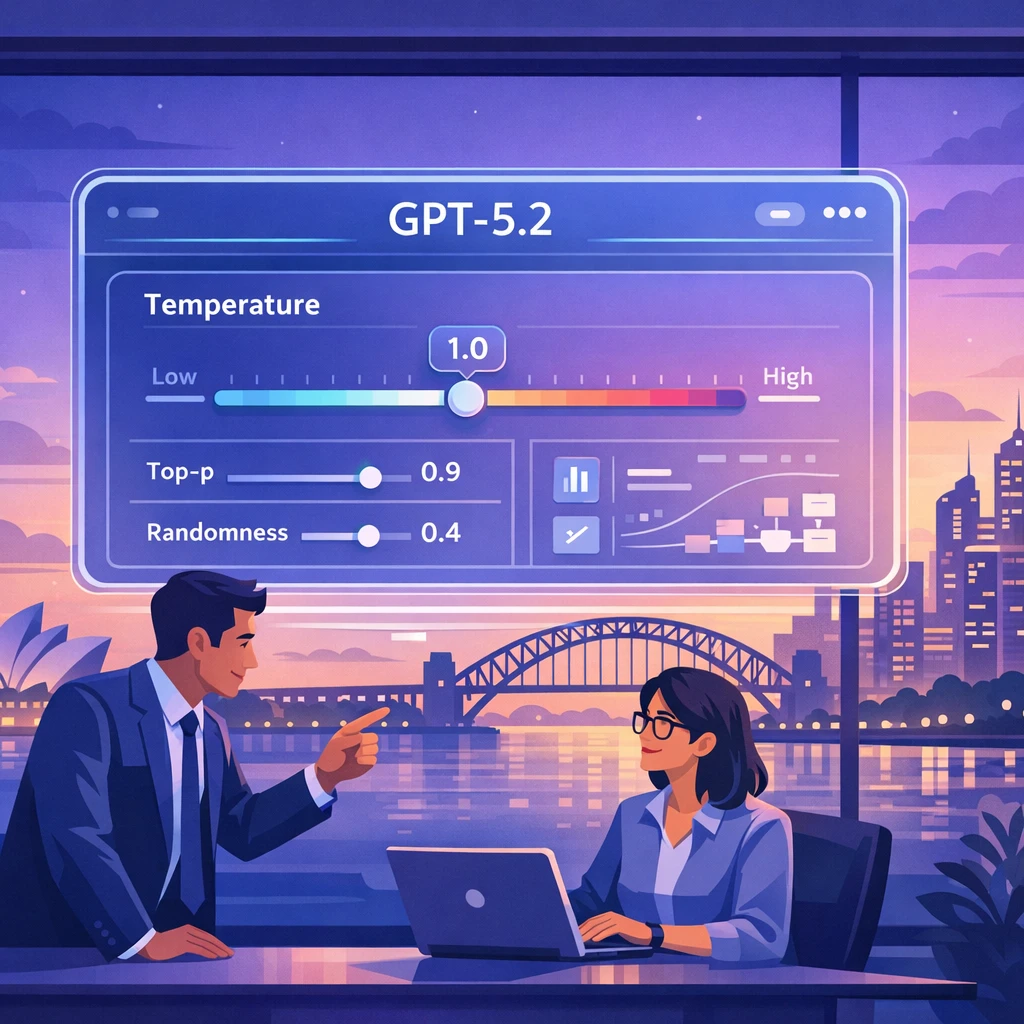
If you’ve ever asked GPT‑style models the same question twice and received two slightly different answers, you’ve already met the idea behind temperature in GPT‑5.2. In plain terms, temperature is just a slider for LLM randomness control: set it low and the model sticks closely to the safest, most likely answer; set it high and it’s more willing to take linguistic risks, explore alternatives, and occasionally wander off the path. Think of it as the difference between a lawyer reading from a template and a copywriter brainstorming headline ideas on a whiteboard.
For Australian enterprises, that quiet dial suddenly becomes very loud. Temperature is one of the few levers that directly affects hallucinations, inconsistent outputs, and even perceived compliance risk. A poorly chosen GPT‑5.2 temperature setting can turn a tightly governed knowledge assistant into a creative fiction engine that invents policy clauses, misstates ASIC guidance, or fabricates “reasonable sounding” citations that don’t exist. The flip side? Lock the temperature too low and your teams complain the system is rigid, repetitive, and borderline unusable for anything beyond basic FAQs.
This guide is written for the people who get blamed when that balance is wrong: CIOs and CTOs designing AI platforms, Heads of Data and AI building internal copilots, and risk, legal, and compliance teams trying to keep enterprise AI governance in Australia aligned with emerging regulatory expectations. If you’re responsible for making sure GPT‑5.2 and Gemini don’t leak confidential data, contradict internal policies, or drift into unauditable behaviour, the details of GPT‑5.2 temperature settings are not an academic curiosity. They’re part of your control framework. In the next sections, we’ll unpack how temperature interacts with other knobs like top‑p, why reasoning models behave differently, and how to standardise settings across use cases without strangling innovation.
In this guide, we’ll break down how temperature works in GPT‑5.2 and Gemini, what’s really going on under the hood, and how Australian enterprises can choose the right settings for legal, operational, and creative use cases. We’ll keep the language simple, but we won’t dumb down the ideas. By the end, you’ll know exactly when to turn the dial down to 0.1—and when cranking it up is actually the smart move.
https://platform.openai.com https://cloud.google.com/vertex-ai
1. Temperature in LLMs: The Core Basics and Definitions
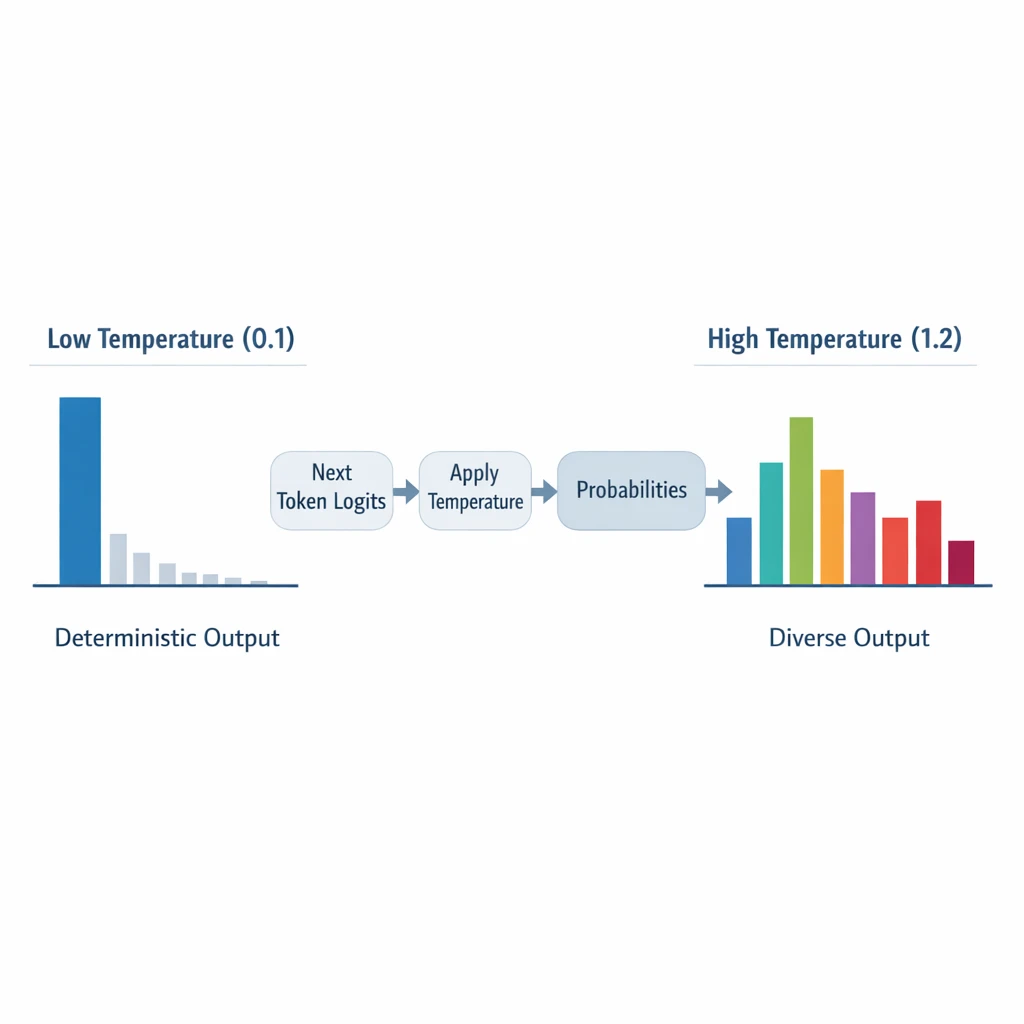
Under the hood, temperature is just a single number between 0.0 and 1.0 (sometimes higher, but that’s rarely useful for enterprise) that reshapes the model’s probability distribution over the next token. Mathematically, it divides the logits before they’re turned into probabilities; practically, it’s the difference between “always pick the safest word” and “let’s occasionally say the surprising thing”. Same model. Same prompt. Very different behaviour.
Here’s a concrete illustration using a simple prompt:
-
Prompt:
"Write a one-sentence product description for an AI assistant for Australian accountants."
|
Temperature |
Example behaviour |
|---|---|
|
|
Nearly identical wording every run, e.g. “An AI assistant that helps Australian accountants automate routine compliance and bookkeeping tasks.” Very safe. Very plain. |
|
|
Minor variation: “An AI assistant that helps Australian accountants streamline tax compliance and daily bookkeeping work.” Still conservative, still on‑policy. |
|
|
Noticeable creativity: “A smart AI sidekick for Australian accountants that handles the grunt work of tax, BAS, and reconciliations so you can focus on advice.” More flavour, more risk. |
|
|
Much wilder swings: “Your always‑on AI co‑pilot for Aussie accounting firms, from messy shoebox receipts to ASIC‑ready reports, without burning your team out.” Punchier, but less predictable. |
Same intent, but as temperature rises you get spread: more lexical variety, more stylistic experimentation, and a slightly higher chance the model drifts into off‑brief territory if your prompt isn’t tight.
For teams wiring GPT‑5.2 into production systems, temperature becomes a configuration primitive, not a vibe. In code or orchestration tools, it usually looks like this:
{
  "model": "gpt-5.2",
  "temperature": 0.2,
  "top_p": 0.9,
  "max_tokens": 512,
  "messages": [
    {"role": "system", "content": "You are a compliant assistant for an Australian bank."},
    {"role": "user", "content": "Summarise this internal policy for branch staff."}
  ]
}
Most enterprise workflows in Australia (policy summaries, email drafts, report generation, customer responses) sit comfortably in the 0.1–0.4 band, with higher temperatures reserved for ideation, copy variants, and exploratory analysis where a bit of controlled chaos is actually useful.
Temperature FAQs for GPT‑5.2
What is a good temperature for GPT‑5.2?
For enterprise‑grade tasks in AU – think regulated communications, internal knowledge assistants, customer support – a starting range of 0.1–0.3 works well. For brainstorming, campaign concepts, or alternative phrasings, try 0.5–0.7, but keep those runs out of fully automated decision paths.
Is higher temperature always more creative?
Not exactly. Higher temperature increases randomness, which can surface more creative wording, but past ~0.8 you often just get noisier, less coherent text. True creativity still depends on prompt quality, context, and the underlying model (see our deeper dive on model behaviour in GPT‑5.2 vs Gemini).
Does temperature affect hallucinations?
Yes, but indirectly. Higher temperature makes the model more willing to pick lower‑probability tokens, which can amplify hallucinations when the model is uncertain or the context is thin. However, bad grounding plus a low temperature can still give you confidently wrong answers – just more consistently. Guardrails, retrieval, and clear system prompts matter more than any single temperature value.
How does temperature interact with top‑p?
Both control randomness, but in different ways. Temperature rescales the whole distribution; top‑p (nucleus sampling) truncates it to the smallest set of tokens whose cumulative probability is below a threshold (e.g. 0.9). In practice: keep one as the main dial and nudge the other gently. A robust default for GPT‑5.2 in enterprise settings is temperature: 0.2–0.3 with top_p: 0.8–0.95; only push both high if you’re explicitly running a creative, human‑in‑the‑loop workflow.
2. GPT‑5.2 vs Gemini: Temperature, Top‑p, and Model Behaviour
Not all models treat temperature the same way. With GPT‑3.5 and GPT‑4, developers were used to dialing temperature and top‑p (nucleus sampling) up and down however they liked. GPT‑5‑family reasoning models changed that dynamic. While you can still configure sampling, newer models such as GPT‑5, o3, and o4‑mini introduce stricter, model‑specific rules and recommended defaults. In practice, that means: you’re encouraged—and sometimes required—to stay close to those defaults, a trend that’s also been noted in analyses of why newer reasoning models expose fewer or more constrained temperature controls in the first place. such as recent commentary on GPT‑5 and o3.
GPT‑5.2 comes in two main variants: GPT‑5.2, the advanced reasoning model, and GPT‑5.2‑Chat, tuned for everyday work and learning. Unlike GPT‑5, where you can freely tweak generation controls, GPT‑5.2 reasoning is exposed more as a “managed” reasoning endpoint: temperature and top‑p are either not user‑configurable or are only available within a narrow, provider‑defined range, and the model is tuned for stable, safety‑aware outputs. Rather than relying on users to dial in randomness, the service is optimized to deliver consistent, high‑quality reasoning out of the box. Internally, it may use more advanced search, planning, or verification strategies than standard chat models, but those details are abstracted away—what you get as a developer is a more deterministic‑feeling, reliability‑first reasoning API rather than a fully open‑ended text generator. In other words, you don’t drive; you set the destination.
GPT‑5.2 chat is different. It may still expose temperature and top‑p like older chat models, but you need to check the SDK or portal. If those fields are missing or your calls fail when you set them, assume sampling is locked. When that happens, your main controls become:
-
Prompt and system instructions
-
Reasoning depth/effort style parameters (where available)
-
External guardrails and validation
Gemini models (Gemini 3 Pro, 3 Flash, 2.5 Pro) on Vertex AI and Google AI Studio go the other way. They expose temperature and top‑p directly, often with UI sliders and code snippets to help you tune them. Defaults vary a bit by model and by where you’re calling them from, but Gemini generally starts you off with a moderate temperature (often around 0.4–0.7 if you don’t touch the controls), and Google’s own guidance still nudges you toward lower temperature for precise, deterministic tasks and higher for open‑ended, creative ones—very much in line with the familiar OpenAI patterns., and aligned with official Vertex AI documentation on tuning parameter values.
The important bit for Australian teams: despite different brands and APIs, the underlying temperature mechanism is essentially the same across providers. What really varies is how much control you’re given for a specific model, especially for reasoning‑oriented variants. However, some experts argue that this generalization is starting to break down with the rise of reasoning‑style models like o1 and o3‑mini. These systems often ship with a effectively fixed temperature and expose no user‑tunable knob at all, which means teams can’t rely on the familiar “just lower T” playbook to tighten outputs. In practice, that suggests there are now at least two distinct interaction patterns in the wild: classic generative models where temperature behaves as expected across providers, and newer reasoning models where controllability is pushed into architecture and training rather than runtime parameters. For Aussie teams, it’s worth recognizing that not every provider—or even every model within a provider—implements temperature as a first‑class control, and strategies may need to diverge accordingly.
https://platform.openai.com https://cloud.google.com/vertex-ai https://learn.microsoft.com
3. Creativity vs Accuracy: The Temperature Trade‑off in GPT‑5.2 and Gemini
Temperature is not just an abstract number. It’s a direct trade‑off between creativity and accuracy. At low temperatures, models tend to follow the “most statistically likely” path. They echo the training data more faithfully, stick closer to clear patterns, and avoid risky guesses. That usually means:
-
Higher factual accuracy
-
Fewer hallucinations
-
More stable reasoning steps
At higher temperatures, especially above 0.8, the model starts exploring the long tail of possibilities. You get:
-
Richer idea diversity and more novel combinations
-
More colourful language and unexpected angles
-
But also more made‑up facts, contradictions, and drift from the prompt
At higher temperatures, the model is more exploratory: you get more surprising connections, more diverse phrasing, and, yes, more made‑up facts. Empirical work on GPT‑style models has shown that increasing temperature tends to boost measured “creativity” (for example, by raising diversity and novelty scores) while reducing factual accuracy compared with very low temperatures. In other words, cranking up the temperature shifts the model toward bolder, less predictable outputs at the cost of being less reliably correct—exactly the tradeoff you’d expect when you’re sampling more aggressively from the model’s probability distribution. The exact numbers differ by task, but the direction is always the same: higher temperature widens the space of possible answers, which naturally includes both more good ideas and more wrong ones, a pattern echoed in independent guides like Understanding Temperature, Top P, and Maximum Length in LLMs.
GPT‑5.2 and modern reasoning models do bring new tools to the table. They use internal self‑verification, reflection, and multi‑pass reasoning to catch some errors before they reach the user. Those mechanisms can soften the downside of higher temperature, but they don’t remove it. When you broaden the probability distribution by turning T up, you still increase the chance of low‑probability, low‑reliability tokens being chosen.
For Australian enterprises, this means you need to decide, per use case: “Do we care more about never being obviously wrong, or about surfacing as many new ideas as possible?” There’s no single right answer—only a temperature profile that matches the risk appetite of that workflow.
https://platform.openai.com https://cloud.google.com/vertex-ai
4. An Enterprise Temperature Playbook for AU Organisations
To make temperature useful in practice, you need a simple playbook. One that a product manager, risk lead, or architect can glance at and say, “Right, for this use case we start at T=0.15.” Here’s a structured way to do that for Australian organisations using GPT‑5.2‑class models and Gemini, whether you’re deploying an AI assistant for everyday tasks or building more specialised internal tools.
4.1 Segment Your Use Cases
Start by grouping your AI scenarios into three broad buckets:
-
Factual & regulated – HR policy Q&A, Fair Work and employment questions, ATO and tax summaries, insurance wording, health and safety content.
-
Operational & support – IT helpdesk bots, internal FAQs, how‑to guides for internal tools, standard operating procedures.
-
Creative & strategic – campaign ideation, messaging boards, product naming, workshop facilitation.
4.2 Recommended Starting Ranges
For chat‑style models such as GPT‑5.2 chat or Gemini Pro/Flash, good starting points are:
-
Factual / regulated:
-
GPT‑style (incl. likely GPT‑5.2 chat): temperature 0.0–0.2, top_p 0.7–0.9
-
Gemini Pro/Enterprise: temperature 0.1–0.3, top_p 0.7–0.9
-
-
Operational assistants:
-
GPT‑style: temperature 0.2–0.5, top_p 0.8–1.0
-
Gemini: temperature 0.3–0.6, top_p 0.8–1.0
-
-
Creative tools:
-
GPT‑style: temperature 0.7–1.1, top_p 0.9–1.0
-
Gemini: temperature 0.8–1.2, top_p 0.9–1.0
-
For chat‑style models such as GPT‑5.2 Chat or Gemini Pro/Flash, good starting points are to keep temperature low for reliability-focused use cases and higher for brainstorming or creative work. For GPT‑5.2 Reasoning, temperature is typically fixed or less exposed as a tuning knob, so you should think of the model itself as the “low‑randomness option” in your stack. Use it primarily for high‑stakes or complex flows where you care more about rigorous reasoning and consistency than about sampling lots of diverse alternatives. For example, your internal policy bot might use GPT‑5.2 reasoning, while a marketing ideation tool uses a tunable Gemini model at higher temperature, with prompts optimised using best‑practice prompt design.
Finally, document your defaults. In regulated AU contexts, being able to show auditors that “all finance‑related prompts run through models at T≤0.2 with top_p≤0.9 and AU‑hosted RAG” is often as important as the raw quality of the answer.
https://platform.openai.com https://cloud.google.com/vertex-ai
5. Governance, Drift, and Compliance at Different Temperatures

Temperature doesn’t just change style. It changes reproducibility. At temperatures near zero, if you send the same prompt repeatedly to a traditional GPT‑3.5/4‑style model with a fixed random seed, you’ll usually see almost identical outputs. That’s gold for audit trails and investigations: you can reasonably say, “This is the answer the system would give to that question.”
As temperature rises, that stability fades. The same prompt at T=0.9 might yield different examples, different argument orders, and sometimes even different conclusions. For a brainstorming tool, that’s a feature. For an internal HR advice bot, it’s a headache.
GPT‑5‑family reasoning models complicate the picture. Even with fixed temperature (often defaulting to 1), they run internal multi‑pass pipelines: multiple reasoning paths, scoring, and selection. This introduces controlled variance, so outputs are intentionally non‑deterministic. You can’t simply set temperature to 0 and call it a day, because that option doesn’t exist. Instead, you approximate determinism using:
-
Caching responses for common prompts
-
Retry and ranking strategies (e.g., choose the majority answer from three runs)
-
Standardised prompt templates and well‑defined system messages
For Australian organisations in regulated sectors—healthcare, insurance, financial services—governance around temperature (and related randomness) should include:
-
Defined temperature/top_p profiles per use case segment
-
Logging of prompts and outputs in AU‑compliant storage
-
Regular expert review of samples to detect hallucinations and style drift
-
Secondary checks or rule‑based filters for high‑risk content, regardless of T
Think of temperature as one dial in a larger safety console. Turning it down helps, but it must sit alongside retrieval over trusted AU‑hosted data, policy‑aware prompts, and clear escalation paths when the model isn’t sure, just as you would in secure AI transcription deployments or other sensitive workflows.
https://platform.openai.com https://cloud.google.com/vertex-ai
6. Practical Tuning Tips for GPT‑5.2 and Gemini Temperature
Let’s make this concrete. How do you actually choose and adjust temperature (and top_p) day to day, especially when GPT‑5.2 reasoning may not expose those controls?
6.1 When to Tune Temperature vs Top‑p
Use temperature as your smooth slider. When you want to move between deterministic and creative behaviour in a gradual way, temperature is your friend. It reshapes the entire probability distribution without cutting anything off. That’s ideal when:
-
You’re designing a general assistant and want to tweak “how chatty” or “how inventive” it feels
-
You’re testing whether a bit more variety helps user engagement without tanking accuracy
Use top_p when you want hard boundaries. Top‑p sorts tokens by probability and keeps only the smallest set whose cumulative probability reaches p (e.g., 0.9). The model then samples from this truncated set. Lowering top_p:
-
Forces the model to choose from only the strongest candidates
-
Prunes rare, potentially unsafe or off‑policy tokens
-
Is especially useful for legal, compliance, and highly formatted outputs
A common enterprise pattern is: keep temperature modest (0.2–0.4) and adjust top_p in the 0.6–0.9 range to fine‑tune how conservative the language feels, particularly for AU legal/compliance scenarios, which aligns with practical guidance on how OpenAI temperature affects output.
6.2 Handling GPT‑5.2 Reasoning’s Locked Temperature
If you find that GPT‑5.2 reasoning rejects temperature or top_p, treat that as a design signal, not a bug. The provider wants to control internal sampling to protect reasoning quality. Your levers then shift to:
-
Choosing when to use GPT‑5.2 reasoning vs a tunable chat/Gemini model
-
Adjusting reasoning_effort (where available) to trade latency vs depth
-
Using external RAG over AU‑hosted content for factual grounding
-
Adding your own “retry and rank” wrapper to smooth out output variance
For RAG‑style enterprise search assistants built on GPT‑5, current patterns recommend omitting temperature/top_p and relying on defaults tuned for reasoning, then improving apparent determinism with caching and consistent prompts rather than by forcing T=0. However, some experts argue that deliberately configuring temperature and top_p still has a place in RAG‑style enterprise search, especially when you need tight control over output behavior across heterogeneous workloads. In highly regulated domains or multi‑tenant platforms, teams sometimes prefer explicitly pinned sampling parameters as a governance and auditing mechanism, ensuring that changes in default reasoning behavior don’t ripple into production unnoticed. Others point out that small, carefully tested deviations from the defaults can improve user experience in edge cases—like handling ambiguous queries, ranking multiple plausible interpretations, or encouraging the model to surface alternative explanations when the underlying documents conflict. From this angle, exposing temperature/top_p behind feature flags and guardrails isn’t about “fighting” the reasoning defaults, but about giving platform owners a precise, versioned dials‑and‑levers interface so they can tune for their specific risk profile and UX goals over time.
6.3 Benchmark Before You Lock In
Finally, don’t guess. For AU‑specific tasks—Fair Work guidance, ATO explanations, internal policy Q&A—benchmark GPT‑5.2 and Gemini at low temperatures (0–0.2) using your own documents. Evaluate:
-
Factual accuracy and citation correctness
-
Answer stability across repeated calls
-
Alignment with your risk and tone requirements
Then lock in profiles per use case and monitor them over time. Change temperature only with a clear reason and a small A/B test to see the impact, in the same spirit you’d use to iterate on AI‑powered IT support for Australian SMBs or other operational assistants.
https://platform.openai.com https://cloud.google.com/vertex-ai
Conclusion: Making Temperature Work for Your AI Strategy
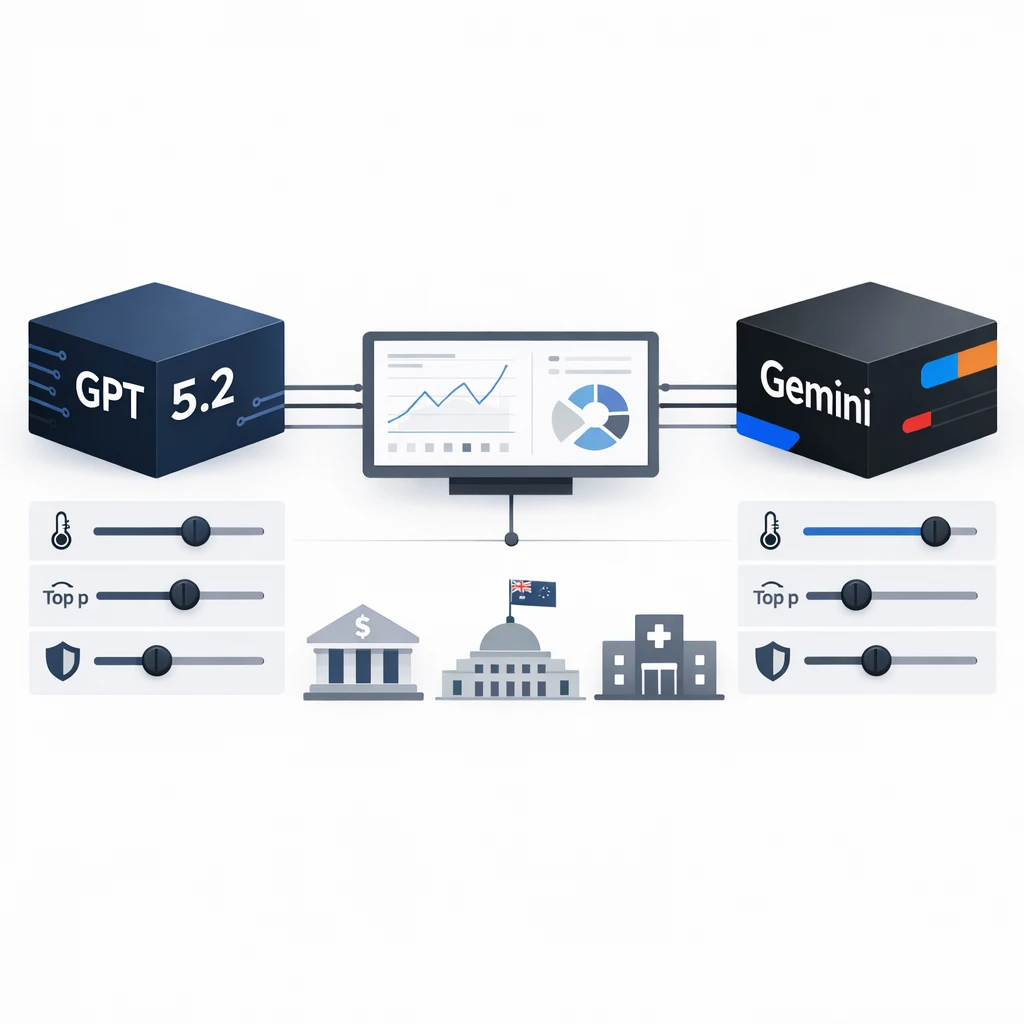
Temperature in GPT‑5.2 and Gemini is more than a technical curiosity. It’s a strategic control that shapes how risky, how repeatable, and how creative your AI becomes. Low temperatures and fixed‑sampling reasoning models support AU‑style compliance, auditability, and consistency. Higher temperatures, used in the right places, unlock fresh ideas and more human‑sounding assistants, whether you’re building a specialised AI partner or a broad internal Copilot.
The shift with GPT‑5‑family models—away from user‑controlled randomness and towards provider‑tuned reasoning—means Australian teams need to rethink old habits. You’ll rely less on cranking T up and down, and more on choosing the right model, routing the right prompts, and layering your own governance and evaluation, guided by resources like comprehensive GPT‑5 migration guides and expert AI implementation services.
If you’re planning or scaling AI inside your organisation and want a clear temperature strategy tailored to your AU regulatory environment, now is the time to design it—before your assistants are everywhere. Define your use‑case segments, pick sensible starting ranges, benchmark GPT‑5.2 and Gemini against your content, and treat temperature as one part of a broader safety and performance system rather than a magic knob. Done well, it quietly supports everything else you build on top, from AI personal assistants for staff through to clinical transcription tools and AI‑augmented education experiences.
https://platform.openai.com https://cloud.google.com/vertex-ai
© 2025 LYFE AI. All rights reserved.
Frequently Asked Questions
What is temperature in GPT-5.2 and why does it matter for enterprise use?
Temperature in GPT-5.2 controls how random or deterministic the model’s outputs are. A low temperature makes answers more predictable and consistent, while a higher temperature increases creativity and variation. For enterprises, this setting directly affects hallucinations, reliability, and perceived compliance risk, so it must be tuned deliberately rather than left at a default.
What temperature should I use for GPT-5.2 in a regulated Australian industry?
For highly regulated sectors in Australia (finance, healthcare, government), most organisations run GPT-5.2 at a low temperature, typically in the 0.0–0.3 range. This keeps outputs closer to the underlying facts and policies, reducing hallucinations and variability between similar prompts. LYFE AI usually pairs low temperature with guardrails, retrieval-augmented generation, and monitoring to meet AFCA, ASIC, APRA, and privacy obligations.
How do I choose the right GPT-5.2 temperature for my specific business use case?
Start by mapping the use case to a spectrum: compliance‑critical (policies, advice, internal knowledge), operational (customer support, workflows), or creative (marketing, ideation). Use low temperatures (0.0–0.3) for compliance‑critical tasks, medium (0.3–0.6) for support and internal ops, and higher (0.6–0.9) only for bounded creative work where errors are low‑risk. LYFE AI typically runs A/B tests on different temperature settings with real user queries, then locks in the one that best balances accuracy, tone, and user satisfaction.
What is the difference between temperature and top-p in GPT-5.2 and Gemini?
Temperature scales how adventurous the model is across the whole set of possible next tokens, while top‑p (nucleus sampling) limits the pool of tokens to the smallest set whose probabilities sum to p. In practice, temperature affects how far the model will stray from the most likely token, and top‑p controls how wide the ‘shortlist’ of options is. LYFE AI generally fixes top‑p to a conservative value and tunes temperature as the primary control so enterprises have a simpler and more predictable knob to govern behaviour.
Does lowering the GPT-5.2 temperature completely stop hallucinations?
Lowering temperature significantly reduces the frequency and variability of hallucinations, but it does not eliminate them entirely. The model can still produce confident but incorrect statements if the source data or prompt is ambiguous. LYFE AI combines low temperature with retrieval from verified knowledge bases, citation requirements, and automated validation checks to keep hallucinations within agreed risk thresholds.
What temperature should I set for an internal AI knowledge assistant in an Australian company?
For an internal knowledge assistant that answers HR, policy, or process questions, most organisations settle between 0.1 and 0.4. The lower end (0.1–0.2) is used for strict policy or procedure answers, while 0.3–0.4 allows slightly more natural language and nuance without drifting far from the source content. LYFE AI typically also enforces retrieval‑only responses for these assistants so the model does not invent information beyond your internal documents.
How should I configure GPT-5.2 temperature differently from Gemini for the same enterprise use case?
Although temperature is conceptually similar across GPT‑5.2 and Gemini, they can feel different at the same numeric setting. Many teams find they need slightly lower temperatures on whichever model tends to be more ‘chatty’ for their prompts. LYFE AI usually standardises behaviour by: fixing top‑p and max tokens, then running quick calibration tests on both models and documenting a ‘normalised’ temperature range per provider for each use case.
How does temperature impact AI governance and compliance for Australian organisations?
Higher temperatures increase variability, which makes it harder to audit, reproduce, and defend outputs if they’re ever reviewed by regulators or in disputes. Lower, well‑documented temperature settings support governance by producing more consistent answers, enabling logging, replay, and human review. As part of AI governance frameworks, LYFE AI helps clients define approved temperature bands per use case, link them to risk ratings, and bake them into MLOps and change‑management processes.
How can I safely use high temperature in GPT-5.2 for marketing and ideation?
You can run GPT‑5.2 at higher temperatures (0.7–0.9) for brainstorming, copy variations, or campaign ideas, but keep it in a sandboxed workflow. Treat all outputs as drafts that must be reviewed by human marketers and checked against brand, legal, and regulatory requirements (including AHPRA and ACCC advertising rules where relevant). LYFE AI often sets up separate “creative” and “production” environments so experimental high‑temperature prompts never directly publish content to customers.
Can LYFE AI help us set and monitor GPT-5.2 temperature policies across our organisation?
Yes. LYFE AI works with Australian enterprises to define temperature standards per use case, implement them in APIs and orchestration layers, and restrict who can change them. We also set up monitoring for drift in model behaviour, log sampling parameters, and integrate alerts or approvals when teams want to experiment outside approved temperature ranges. This makes your AI estate more controllable, auditable, and aligned with internal risk and compliance frameworks.